
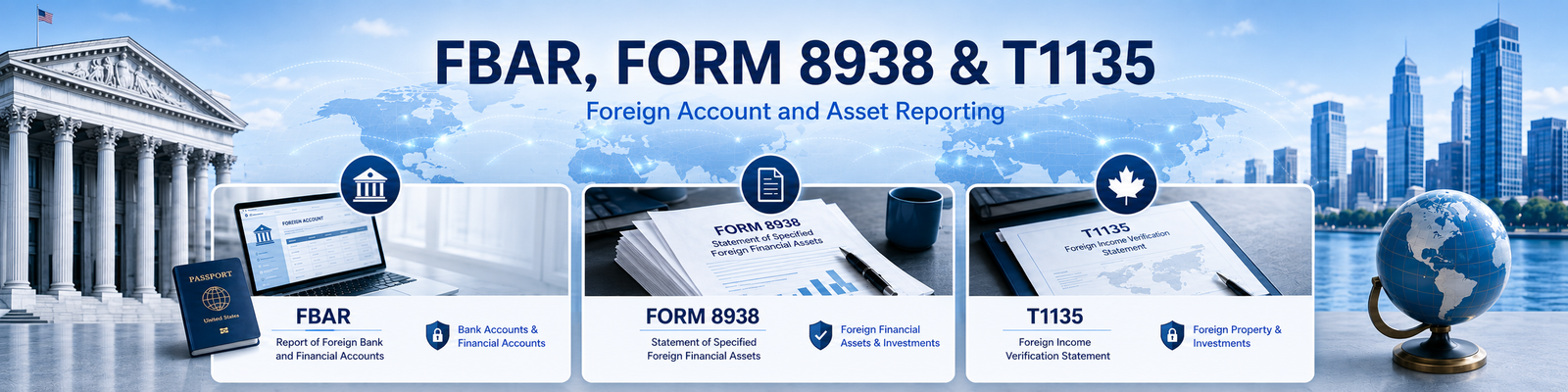
FBAR, Form 8938, and T1135 Reporting for U.S. Citizens in Canada
U.S. citizens and green card holders living in Canada often have foreign account and asset reporting obligations in both countries. The rules can overlap, but the forms are not the same.
Bank accounts, investment accounts, pensions, registered accounts, foreign securities, and other financial assets may need to be reviewed for FBAR, Form 8938, and Canadian T1135 reporting.
The challenge is not simply whether an account exists. The correct reporting can depend on ownership, signing authority, account values, account type, asset classification, residency status, filing thresholds, and whether prior-year filings were complete.
Need help reviewing foreign account and asset reporting?
We can help identify which accounts and assets may need to be reported, organize the required information, and coordinate U.S. and Canadian foreign reporting obligations.
Why Foreign Reporting Is a Common Problem for U.S. Persons in Canada
U.S. persons in Canada often assume that Canadian accounts are local accounts and therefore do not create U.S. foreign reporting issues. For U.S. tax purposes, however, Canadian accounts are generally foreign financial accounts.
At the same time, Canadian residents may also have Canadian foreign asset reporting obligations for non-Canadian property. This means a person can have overlapping U.S. and Canadian reporting obligations, but each form has different rules.
This issue commonly affects:
- U.S. citizens living in Canada
- Green card holders living in Canada
- Canadian residents with U.S. or other non-Canadian investment accounts
- Taxpayers with Canadian bank, brokerage, TFSA, RESP, RRSP, FHSA, or other financial accounts
- Taxpayers with foreign securities, foreign funds, or foreign pensions
- Taxpayers who filed income tax returns but missed separate foreign reporting forms
Many taxpayers only discover the issue after several years, especially where an account was properly reported for income tax purposes but not reported on a separate information form.
What Are FBAR, Form 8938, and T1135?
These forms all involve foreign accounts or foreign assets, but they serve different purposes and use different thresholds, definitions, and filing systems.
Because the forms are similar in theme but different in detail, it is easy to over-report some items, miss others, or assume that filing one form satisfies another obligation.
Comparison of FBAR, Form 8938, and T1135
The following table provides a high-level comparison. The actual filing requirement depends on the taxpayer’s specific facts.
| Form | Who May Need to File | What It Generally Covers | Common Threshold | Common Issues |
|---|---|---|---|---|
| FBAR | U.S. persons with foreign financial accounts where filing thresholds are met. | Foreign bank, brokerage, and certain other financial accounts. | Aggregate value of foreign financial accounts exceeds US$10,000 at any time during the calendar year. | Maximum account values, joint accounts, signing authority, missing historical filings, and penalty concerns. |
| Form 8938 | Specified individuals and certain taxpayers with specified foreign financial assets above applicable thresholds. | Foreign financial accounts and certain other foreign financial assets, depending on the facts. | For specified individuals living outside the U.S., generally more than US$200,000 at year-end or US$300,000 at any time if unmarried or filing separately; generally more than US$400,000 at year-end or US$600,000 at any time if married filing jointly. | Overlap with FBAR, account versus asset classification, thresholds, and coordination with the U.S. tax return. |
| T1135 | Canadian residents with specified foreign property above the Canadian reporting threshold. | Specified foreign property such as foreign accounts, foreign securities, certain foreign interests, and other reportable property. | Total cost amount of specified foreign property exceeds C$100,000 at any time during the year. | Detailed versus simplified method, maximum cost amount, income reporting, country codes, and Canadian-resident portion of the year. |
Why These Forms Are Often Confused
Foreign reporting forms can be confusing because the same account or investment may be viewed differently under U.S. and Canadian rules.
For example, a U.S. citizen living in Canada may need to consider U.S. reporting for Canadian bank and investment accounts. A Canadian resident may also need to consider T1135 reporting for U.S. or other non-Canadian property.
Common Reporting Issues
Foreign account and asset reporting becomes more complicated where a taxpayer has multiple accounts, joint ownership, investments held in different countries, or incomplete historical records.
Common issues include:
- Determining whether an account is reportable
- Calculating maximum account values
- Identifying joint accounts and signing authority accounts
- Coordinating FBAR and Form 8938 reporting
- Determining whether Canadian T1135 reporting applies
- Classifying foreign securities and foreign funds
- Reviewing prior-year omissions
- Organizing records for late or amended filings
How We Help
We help U.S. citizens, green card holders, Canadian residents, and cross-border taxpayers identify and organize foreign account and asset reporting obligations.
Depending on the engagement, we can assist with:
- Reviewing accounts and assets for FBAR reporting
- Reviewing accounts and assets for Form 8938 reporting
- Reviewing Canadian T1135 reporting requirements
- Identifying overlapping U.S. and Canadian reporting obligations
- Organizing maximum account value information
- Classifying foreign accounts, securities, funds, and pensions
- Reviewing prior-year foreign reporting omissions
- Preparing workpapers for current-year or late filings
- Coordinating foreign reporting with U.S. and Canadian tax returns
- Supporting Streamlined, amended, or voluntary disclosure reviews where applicable
Documents Commonly Needed
The documents needed depend on the facts, but may include:
Account and asset records
- Year-end bank and brokerage statements
- Monthly or annual account statements
- Maximum account value information
- Account numbers and financial institution names
- Country of each financial institution or asset
- Details of joint accounts or signing authority accounts
Tax and filing records
- Prior U.S. tax returns
- Prior Canadian tax returns
- Prior FBAR filings, if available
- Prior Forms 8938, if any
- Prior T1135 filings, if any
- Foreign income and investment income schedules
Common Warning Signs
You may need a foreign reporting review if:
- You are a U.S. citizen or green card holder living in Canada
- You have Canadian bank or investment accounts
- You have foreign accounts that were not reported on prior FBARs
- You filed a U.S. tax return but did not include Form 8938
- You are a Canadian resident with U.S. or other foreign investment accounts
- You filed a Canadian return but did not consider T1135
- You have joint accounts, signing authority, or family accounts
- You are considering Streamlined filing, amended returns, or voluntary disclosure
Frequently Asked Questions
Is FBAR filed with my U.S. tax return?
No. FBAR is filed separately through FinCEN’s system, not as part of the Form 1040 package. It is still an important U.S. foreign account reporting obligation.
If I file FBAR, do I still need Form 8938?
Possibly. FBAR and Form 8938 are separate forms with different rules, thresholds, and filing systems. Filing one does not automatically eliminate the need to consider the other.
Do Canadian bank accounts count as foreign accounts for U.S. reporting?
For a U.S. person, Canadian financial accounts are generally foreign accounts. Whether they must be reported depends on the applicable filing thresholds and facts.
Does T1135 apply to Canadian accounts?
T1135 is a Canadian form for specified foreign property. Canadian accounts themselves are generally not foreign property for Canadian T1135 purposes, but U.S. and other non-Canadian accounts or assets may need to be reviewed.
Are registered accounts such as TFSAs, RESPs, and FHSAs reportable?
They may need to be reviewed for U.S. foreign account reporting, depending on the account and the facts. Canadian registered status does not necessarily control the U.S. reporting treatment.
What if I missed prior-year FBARs, Forms 8938, or T1135 filings?
The best approach depends on the forms missed, whether income was also omitted, the number of years involved, and whether a late-compliance, amended filing, Streamlined, or voluntary disclosure approach should be considered.
Do I need exact maximum account balances?
Exact records are preferred, especially for FBAR and other foreign reporting workpapers. Where records are incomplete, it may be necessary to reconstruct values using available statements and reasonable documentation.
Official Government Resources
For official guidance on foreign account and asset reporting, you can also review these government resources directly:
- FinCEN FBAR filing information
- FinCEN BSA E-Filing system for FBAR submissions
- IRS comparison of Form 8938 and FBAR requirements
- IRS information about Form 8938
- IRS FATCA reporting summary for U.S. taxpayers
- CRA Form T1135 information
- CRA guidance on specified foreign property reporting
Need Help With FBAR, Form 8938, or T1135 Reporting?
If you are a U.S. citizen, green card holder, Canadian resident, or cross-border taxpayer with foreign accounts or assets, it is worth reviewing whether additional foreign reporting applies.
We can help identify the relevant forms, organize the records, review prior-year omissions, and prepare a clear compliance plan.
Disclaimer: This page provides general information only and does not constitute legal, tax, accounting, investment, or financial advice. FBAR, Form 8938, and T1135 reporting depends on the specific facts, accounts, assets, residency status, ownership, values, prior filings, and applicable thresholds. You should obtain advice based on your own circumstances before taking action.